A Meeting In Darkness
Prompt
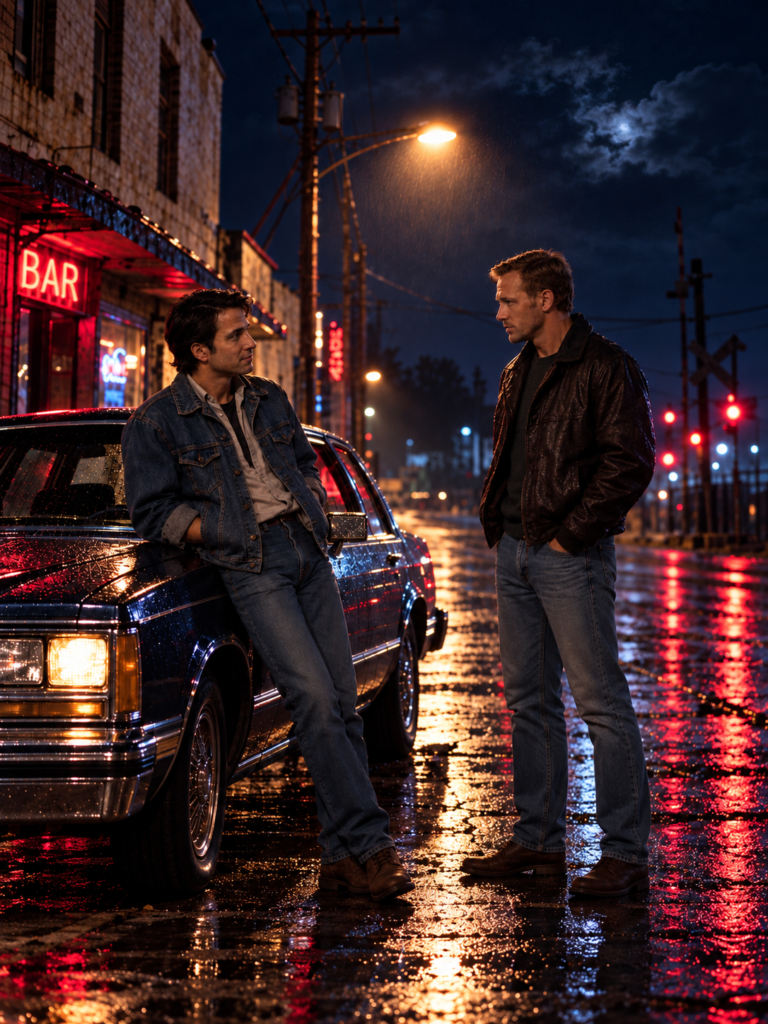
# MASTER SCENE PROMPT — 1980s RAINY NIGHT CONVERSATION

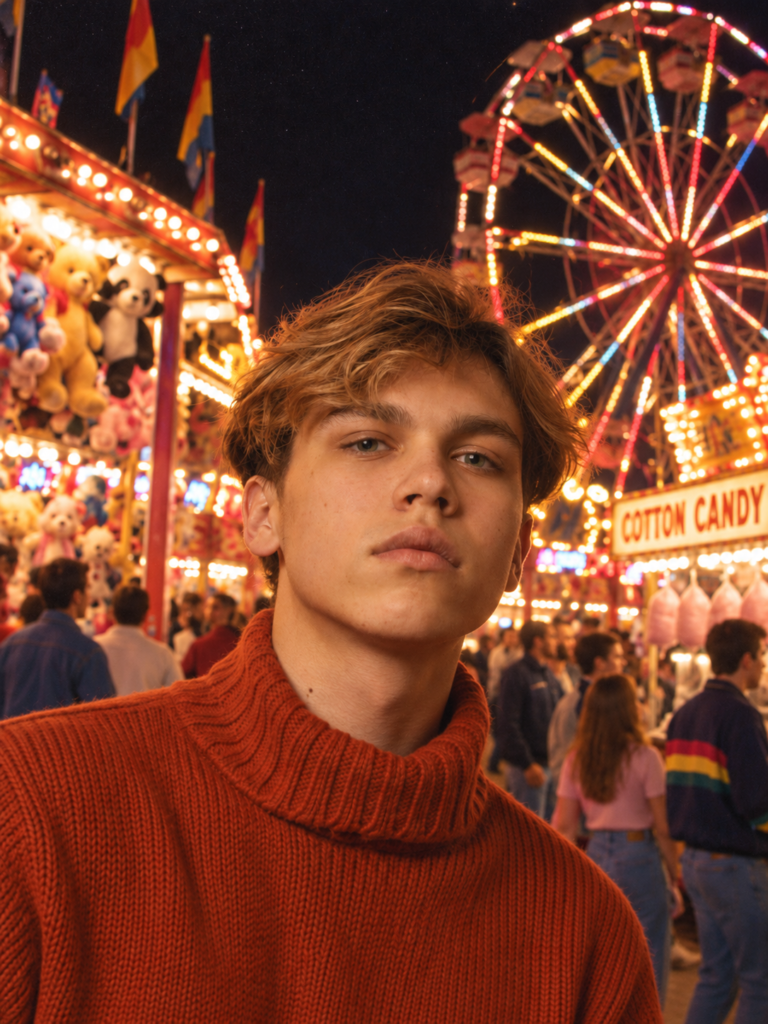
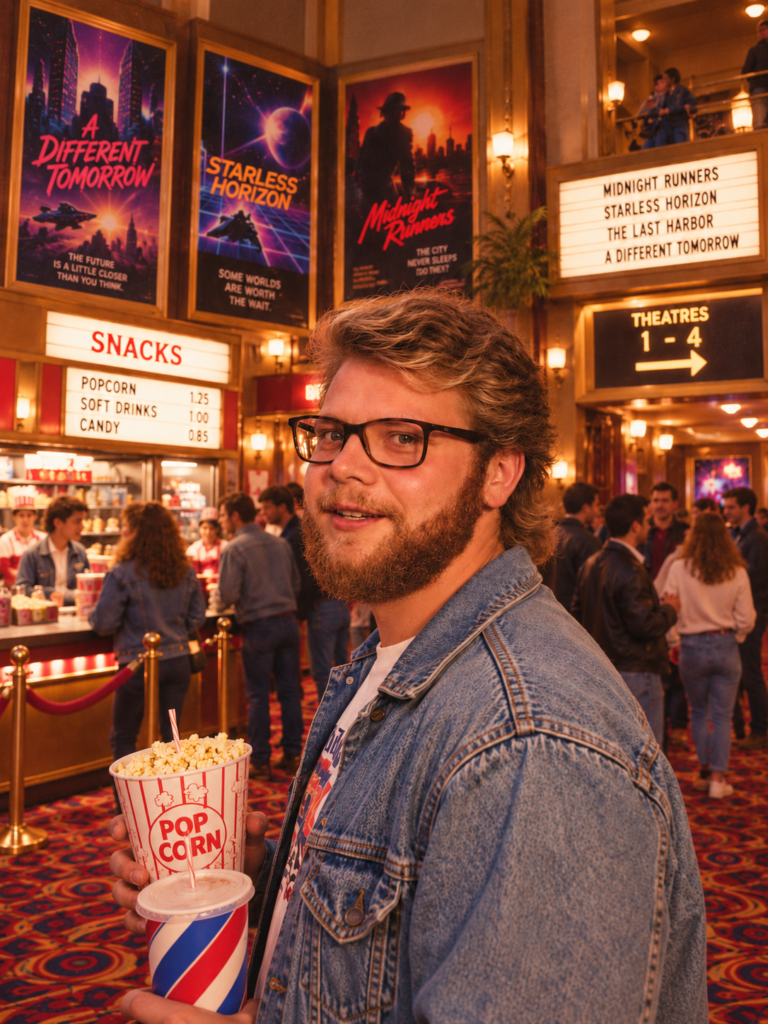
Use the uploaded reference photographs as strict HUMAN IDENTITY REFERENCES for the two main characters.

REFERENCE IMAGE A = CHARACTER A
The person who will appear on the LEFT side of the final image, leaning naturally against the vintage car.

REFERENCE IMAGE B = CHARACTER B
The person who will appear on the RIGHT side of the final image, standing opposite Character A and beginning a conversation with him.

The uploaded reference photographs are primarily evidence of HUMAN IDENTITY.

Do NOT copy their original backgrounds, original lighting, original clothing, original photographic style, original camera angle, or modern surroundings unless explicitly requested.

The final image must place these exact real people naturally inside the cinematic scene described below.

==================================================
IDENTITY PRESERVATION — ABSOLUTE PRIORITY
==================================================

The identities of both people are NON-NEGOTIABLE.

Both characters must remain unmistakably recognizable as the exact individuals shown in their respective uploaded reference photographs.

For CHARACTER A preserve accurately:

- exact overall face shape
- natural face width
- natural face height
- forehead size and proportions
- hairline
- hair density
- hair texture
- hairstyle identity
- eyebrow shape
- eyebrow thickness
- eye shape
- eye size
- eye spacing
- eyelid structure
- iris appearance
- nose length
- nose width
- nose bridge structure
- nostril shape
- cheekbone structure
- natural cheek fullness
- mouth width
- lip shape
- philtrum length
- jawline
- chin shape
- ear proportions
- skin tone
- apparent age
- facial hair if present
- distinguishing facial characteristics
- natural facial asymmetry
- body proportions

For CHARACTER B preserve the same degree of identity accuracy:

- exact face shape
- natural skull and forehead proportions
- hairline and hairstyle identity
- eyebrow anatomy
- eye shape and spacing
- nose structure
- mouth and lips
- cheeks
- jawline
- chin
- ears
- skin tone
- apparent age
- facial hair
- body proportions
- natural asymmetry
- all recognizable characteristics

Do NOT replace either person with a generic handsome actor.

Do NOT beautify them into different people.

Do NOT create idealized Hollywood versions of their faces.

Do NOT change ethnicity.

Do NOT de-age or age either character unless naturally implied by the reference.

Do NOT narrow, widen, elongate, compress or redesign either face.

Both eyes must remain anatomically coherent on the same facial plane.

Never sacrifice identity for dramatic lighting, attractiveness, composition, wardrobe or cinematic mood.

The first question before finalizing the image must be:

“Do these two characters still look unmistakably like the exact people in the uploaded reference photographs?”

If not, correct the identities before finalizing.

==================================================
CORE CINEMATIC CONCEPT
==================================================

Create ONE exceptionally convincing photorealistic cinematic frame from a fictional 1980s crime drama.

The image depicts a quiet but emotionally charged encounter between two men outside a small roadside bar shortly after midnight.

They have just stopped opposite each other and are beginning an important conversation.

The viewer should feel that something occurred before this moment and that something meaningful may happen immediately afterward.

The story must remain slightly ambiguous.

Do not make the characters visibly violent.

Do not make the scene action-heavy.

Do not create a confrontation involving weapons.

Instead, create restrained cinematic tension.

The emotional feeling should be:

quiet suspicion,
recognition,
unspoken history,
cautious conversation,
mutual attention,
and subtle uncertainty.

The moment should feel observed by a movie camera rather than staged for a photographer.

This is NOT a fashion photograph.

This is NOT a studio portrait.

This is NOT an advertisement.

This is NOT an AI retro poster.

This must feel like an authentic frame extracted from a real narrative movie photographed during the 1980s.

==================================================
SELECTED PERIOD
==================================================

Set the scene specifically around:

1986–1988

Maintain chronological consistency throughout the image.

Architecture, automobile design, street infrastructure, clothing, footwear, signage, materials and lighting fixtures must all be believable for the late 1980s.

Do not mix obvious 1970s objects with obvious 1990s objects.

Absolutely no contemporary technology or modern visual elements.

==================================================
ASPECT RATIO
==================================================

VERTICAL 3:4

One single image.

No collage.

No split screen.

No comparison panel.

No border.

No poster layout.

No title typography.

==================================================
CAMERA AND FRAMING
==================================================

Use a medium-wide to full-body cinematic composition.

Both characters should be visible approximately from head to feet.

Do not crop either character awkwardly at the knees, ankles, forehead or shoulders.

Character A occupies the LEFT third of the image.

Character B occupies the RIGHT-middle portion of the image.

Maintain enough space between them to make their conversation visually readable.

They should be separated by roughly 1.5 to 2.5 meters.

Their bodies should form a subtle visual triangle with the vintage car.

Camera height:

approximately chest-to-eye level,
slightly below natural eye level if needed,
but never an exaggerated low angle.

Camera perspective:

natural cinematic perspective,
approximately 35mm to 40mm motion-picture lens equivalent.

The perspective must preserve facial geometry.

No fisheye distortion.

No exaggerated ultra-wide stretching.

No artificial portrait-camera compression.

The camera should feel positioned several meters away, quietly observing the conversation.

Both men should be large enough in the frame for their facial features to remain clearly recognizable.

The car, bar façade, streetlamp and wet road must remain visible as narrative environment.

The composition should preserve significant vertical depth:

upper section:
night sky, power lines and streetlamp

middle section:
faces, bar façade, neon sign and conversation

lower section:
vintage car, full-body stance, wet pavement and reflections

==================================================
CHARACTER A — LEFT SIDE / LEANING ON CAR
==================================================

Place Character A on the LEFT side of the composition.

Character A is leaning naturally against the front-side section of a parked vintage American sedan.

His hip and part of his lower back or shoulder should physically contact the vehicle.

His weight distribution must clearly communicate that he is resting against the car.

He should NOT look like he is floating next to it.

He should NOT simply stand beside it.

The physical contact between Character A and the vehicle must look completely natural.

Suggested posture:

one hip resting against the car,
upper torso slightly relaxed,
one shoulder subtly supported by the vehicle,
one leg bearing less weight,
feet positioned naturally,
hands casually inside jacket pockets or one hand inside a pocket,
shoulders relaxed but attentive.

Character A turns his head and upper torso toward Character B.

Character A is looking directly at Character B.

His expression should suggest:

quiet confidence,
recognition,
attention,
slight curiosity,
and restrained seriousness.

No exaggerated smile.

No angry grimace.

No theatrical expression.

His body language should indicate that he was already waiting beside the car before Character B arrived.

==================================================
CHARACTER B — RIGHT SIDE / OPPOSITE CHARACTER A
==================================================

Place Character B on the RIGHT side of the frame.

Character B has already approached Character A and stopped.

He is no longer walking.

He is standing opposite Character A at a believable conversational distance.

His torso should face Character A.

His head should turn naturally toward Character A.

Character B must make clear direct eye contact with Character A.

His stance should be relaxed but slightly guarded.

Suggested posture:

feet naturally apart,
weight distributed unevenly,
shoulders slightly forward,
one or both hands inside jacket pockets,
body subtly angled toward Character A.

The stance should feel like someone who has just arrived and is deciding what to say.

His expression should communicate:

conversational attention,
subtle concern,
quiet seriousness,
recognition,
or restrained tension.

No exaggerated anger.

No smile toward the camera.

Character B must NOT look at the viewer.

Character B must NOT pose like a fashion model.

==================================================
EYELINE — CRITICAL
==================================================

The characters must look directly at EACH OTHER.

Character A looks toward Character B.

Character B looks toward Character A.

Their eyelines must physically connect.

Do not make either person look past the other.

Do not make either character look at the camera.

Do not create mismatched gaze directions.

The eye contact is one of the most important storytelling elements of the entire frame.

==================================================
FACIAL VISIBILITY
==================================================

Both faces must remain clearly visible.

Use three-quarter facial angles rather than extreme side profiles.

Do NOT place either face completely in silhouette.

Character A:

approximately three-quarter face turned toward the right.

Character B:

approximately three-quarter face turned toward the left.

Both eyes should remain reasonably readable whenever anatomically possible.

Important facial landmarks must remain visible:

eyes,
nose,
mouth,
jaw,
cheeks,
forehead,
hairline.

The dramatic lighting may create shadow, but it must never erase identity.

==================================================
CHARACTER A WARDROBE
==================================================

Restyle Character A naturally into understated late-1980s casual menswear.

Use:

a medium-blue vintage denim jacket,
slightly relaxed fit,
authentic worn denim texture,
subtle seams,
realistic metal buttons,
period-correct construction.

Under the jacket:

a light gray,
off-white,
or muted beige casual button shirt,
slightly open at the collar.

A darker undershirt may be subtly visible underneath.

Bottom:

classic blue straight-cut denim jeans.

Do NOT use modern skinny jeans.

Do NOT use oversized contemporary streetwear.

Footwear:

brown leather boots,
simple late-1980s everyday design,
slightly worn but maintained.

The clothing must look genuinely worn by a real person.

Avoid costume-party styling.

==================================================
CHARACTER B WARDROBE
==================================================

Dress Character B in understated late-1980s masculine clothing.

Primary outerwear:

dark brown or near-black leather jacket.

The leather should show:

natural wrinkles,
subtle wet sheen,
visible seams,
realistic thickness,
period-appropriate construction.

Underneath:

dark charcoal,
dark muted green,
black,
or deep gray knit sweater.

Bottom:

medium-blue straight-cut jeans.

Footwear:

dark brown or black leather boots.

No modern sneakers.

No visible contemporary branding.

No modern fashion silhouettes.

==================================================
VINTAGE CAR — LOCKED ELEMENT
==================================================

The car is an essential narrative element.

Use a believable late-1980s American four-door sedan.

Overall character:

boxy,
long hood,
substantial body,
dark blue or extremely dark navy paint,
chrome detailing.

Required visible design characteristics:

rectangular headlights,
chrome bumper,
period-correct grille,
chrome window trim,
classic side mirror,
period-correct wheels,
period tire proportions,
boxy roofline,
large windows,
substantial metal bodywork.

Do NOT use a modern car.

Do NOT use a futuristic retro concept car.

Do NOT use an exotic sports car.

Do NOT use a luxury supercar.

The vehicle should look like an ordinary but well-kept late-1980s sedan.

Surface condition:

recent rain droplets,
wet hood,
wet roof,
wet windshield,
realistic neon reflection,
subtle streetlight reflection,
natural chrome highlights.

The front-left headlight may emit a warm yellowish tungsten glow.

Only physically correct reflections.

No impossible mirrored surfaces.

==================================================
BAR BUILDING — LEFT BACKGROUND
==================================================

Behind Character A and the vehicle is a small aging neighborhood bar.

The architecture should feel modest, slightly worn and believable.

Use:

aged brick,
weathered masonry,
dark window frames,
old awning,
slightly worn doorway,
simple storefront proportions.

The building should occupy much of the LEFT background.

Do not make it glamorous.

Do not make it a modern nightclub.

Do not transform it into cyberpunk architecture.

It should look like a real working neighborhood bar from a modest late-1980s American or North-American industrial district.

==================================================
NEON BAR SIGN — LOCKED
==================================================

A simple red neon sign reading:

BAR

must be visible on the LEFT side.

The word “BAR” should be one of the only clearly readable pieces of text in the image.

Use large simple block letters.

The neon tubing should produce believable light.

Red glow should interact physically with:

the building wall,
awning,
car paint,
wet street,
Character A’s jacket edge,
nearby window surfaces.

Do NOT add extra slogans.

Do NOT generate random meaningless text.

Do NOT add brand logos.

==================================================
STOREFRONT WINDOW
==================================================

A small window near the bar entrance may contain restrained period neon.

Use subtle red, blue or pale-white glowing shapes suggesting an old beer or bar sign.

The secondary sign does NOT need readable words.

Avoid clutter.

Avoid giant graphic advertising.

The window should reflect rain and streetlight naturally.

==================================================
STREET ENVIRONMENT
==================================================

The characters stand beside a quiet urban or small-town industrial street after midnight.

The road should extend deeply behind them.

Create believable spatial layering:

FOREGROUND:
wet asphalt,
puddles,
reflection,
front section of vintage car.

MIDDLE GROUND:
Character A,
Character B,
bar façade,
streetlamp,
curb,
road.

BACKGROUND:
utility poles,
overhead electrical lines,
small distant buildings,
dim signage,
a few distant vehicle lights,
railway crossing infrastructure,
red signal lights,
dark silhouettes.

The environment should feel like it genuinely exists outside the frame.

==================================================
STREETLAMP — MAJOR LIGHT SOURCE
==================================================

Include one tall curved streetlamp slightly behind and above the two characters.

Position the lamp approximately near the upper-center of the frame.

The streetlamp emits warm amber/yellow tungsten light.

This is the dominant motivated source illuminating the conversation.

It should illuminate:

Character B’s upper body,
parts of Character A,
the wet pavement,
rain in the air,
the car roof and hood.

The light must fall in a physically consistent direction.

Shadows must correspond to this streetlamp.

==================================================
NIGHT SKY
==================================================

Use a deep navy-blue to nearly black midnight sky.

Add natural heavy clouds.

A subtle partial moon may appear behind the clouds toward the upper-right background.

The moon should remain secondary.

No giant dramatic fantasy moon.

No stars dominating the frame.

The clouds should receive restrained moonlight.

The sky must remain realistic.

==================================================
UTILITY INFRASTRUCTURE
==================================================

Include authentic utility poles.

Wooden power poles.

Period electrical transformers if visible.

Overhead cables crossing diagonally through the upper portion of the image.

The lines should support depth and perspective.

Do not create chaotic impossible cable geometry.

==================================================
RAILROAD CROSSING — DISTANT RIGHT BACKGROUND
==================================================

In the far-right background, include understated railroad crossing infrastructure.

Possible visible elements:

crossbuck silhouette,
red signal lamps,
simple metal posts.

The red crossing lights should appear small and distant.

They should add narrative depth but must NOT compete with the characters.

Their red reflections may appear faintly on the wet street.

==================================================
WEATHER
==================================================

The scene takes place immediately after or during very light nighttime rain.

The street is fully wet.

The characters and vehicle may contain subtle realistic moisture.

Visible rain should remain restrained.

Do NOT create a tropical storm.

Do NOT obscure faces with rain.

Small rain streaks may become visible specifically under the streetlamp.

==================================================
WET PAVEMENT — CRITICAL VISUAL ELEMENT
==================================================

The asphalt is dark, old and slightly uneven.

Use:

small puddles,
fine cracks,
subtle surface irregularity,
wet curb,
rainwater,
glistening patches.

Reflections should include:

warm amber streetlamp,
red BAR neon,
small red railroad signals,
cool distant blue-white lights.

The reflected lights should stretch vertically and irregularly across the wet road.

Avoid perfect mirror reflections.

Water reflections must follow road perspective and surface roughness.

The lower third of the image should contain especially rich environmental reflections.

==================================================
LIGHTING LOGIC
==================================================

Use one physically coherent nighttime lighting system.

Dominant source:

warm overhead streetlamp.

Secondary sources:

red neon BAR sign,
dim blue/cool storefront light,
small distant street signals,
subtle cool moonlit ambient sky.

Character A should receive:

soft warm streetlight,
subtle red neon edge light,
cool ambient fill.

Character B should receive:

more direct warm streetlamp illumination,
subtle cool night fill,
minor distant red reflections.

Both faces must remain clearly readable.

Do NOT use invisible studio beauty lights.

Do NOT use fashion-photography rim lighting.

All illumination must appear motivated by visible environmental sources.

==================================================
COLOR PALETTE
==================================================

Use environment-driven color.

Primary colors:

deep navy night,
warm amber streetlight,
dark wet asphalt,
dark blue automobile,
muted blue denim,
dark brown leather,
red neon highlights.

Secondary colors:

small amounts of cool blue,
dim white,
muted green,
soft neutral skin tones.

Do NOT create an exaggerated cyan-magenta cyberpunk image.

Do NOT apply a contemporary teal-orange blockbuster grade.

The red neon should feel naturally produced by the physical sign.

==================================================
CINEMATIC FILM CHARACTER
==================================================

The final image must resemble a well-preserved frame photographed on professional 35mm motion-picture film during the late 1980s.

Use:

organic fine-to-medium 35mm grain,
subtle film color response,
gentle highlight roll-off,
slightly softened microcontrast,
natural shadow density,
subtle halation around intense neon and streetlights,
very mild optical softness,
natural focus falloff,
restrained lens flare,
slight exposure imperfection.

Skin must retain real human texture.

Fabric must retain realistic weave.

Leather must look physically correct.

Metal and chrome must reflect the environment naturally.

Wet pavement must behave realistically.

Avoid digitally perfect surfaces.

==================================================
DEPTH OF FIELD
==================================================

Use moderate cinematic depth of field.

Both characters must remain sharply readable.

The car and nearby bar architecture should remain relatively detailed.

The distant background may become gradually softer.

Do NOT use extreme modern f/1.2 portrait blur.

Do NOT completely erase the background.

The environment remains narratively important.

==================================================
PHOTOGRAPHIC REALISM
==================================================

The image should look genuinely photographed.

Not rendered.

Not illustrated.

Not painted.

Not generated as concept art.

Skin:

natural pores,
natural tonal variation,
no waxy texture,
no artificial skin smoothing.

Hair:

individual natural strands,
appropriate wetness,
realistic density.

Denim:

visible woven texture,
natural folds,
proper seams.

Leather:

natural creasing,
specular highlights,
physical thickness.

Chrome:

accurate reflection.

Glass:

correct transparency and reflection.

Rainwater:

proper interaction with surfaces.

==================================================
MISE-EN-SCÈNE
==================================================

Every major object must contribute to the story.

Character A and car:
suggest someone was already waiting.

Character B:
suggests someone has just arrived.

BAR sign:
establishes location and visual tone.

Streetlamp:
creates a natural meeting point.

Wet road:
enhances atmosphere and visual depth.

Railroad crossing:
suggests an industrial district and world beyond the conversation.

Power lines and old buildings:
reinforce period realism.

Nothing should appear simply because it looks “retro.”

==================================================
BODY LANGUAGE
==================================================

Character A:

relaxed,
leaning against vehicle,
slightly guarded,
already settled in the location.

Character B:

standing,
recently arrived,
slightly more formal posture,
attention completely focused on Character A.

Their shoulders and feet must naturally support the conversational relationship.

No mirrored poses.

No symmetrical fashion stance.

No exaggerated gesture.

No pointing.

No arms crossed unless absolutely natural.

No dramatic hand gestures.

This is the first few seconds of a restrained conversation.

==================================================
NARRATIVE IMPRESSION
==================================================

The viewer should intuitively feel:

Character A was waiting beside the vehicle.

Character B approached from somewhere across or down the street.

Character B has now stopped.

They recognize each other.

Their eyes meet.

One of them has just spoken or is about to speak.

The conversation may be important.

The viewer does not yet know whether they are:

friends,
old acquaintances,
business partners,
or people with unresolved history.

Keep the story unresolved.

==================================================
DO NOT TURN THIS INTO A PORTRAIT
==================================================

The people must exist inside a scene.

Do not place them against a simplified background.

Do not create shallow background blur just to emphasize faces.

Do not center both characters symmetrically.

Do not make them pose for the camera.

Do not make their clothing unnaturally pristine.

Do not use studio lighting.

Do not present the vehicle like a commercial product.

The camera happened to capture this moment.

==================================================
LOCKED SCENE ELEMENTS
==================================================

These elements MUST remain:

vertical 3:4 orientation

two male characters based on the two uploaded identity references

Character A on the LEFT

Character B on the RIGHT

Character A leaning physically against the car

Character B standing opposite him

both characters facing each other

direct mutual eye contact

both faces clearly recognizable

late-1980s wardrobe

dark vintage American sedan

old neighborhood bar on left

red neon BAR sign

wet nighttime road

warm overhead streetlamp

dark cloudy sky

power poles and overhead cables

distant railroad crossing signals

red, amber and subtle blue reflections

natural cinematic conversation

authentic 35mm movie-frame appearance

==================================================
MODERN ELEMENT EXCLUSION
==================================================

Absolutely NO:

smartphones
smartwatches
wireless earbuds
modern cars
EVs
LED billboards
LED strips
QR codes
touchscreens
modern laptops
modern sneakers
contemporary street furniture
modern luxury architecture
digital signage
flat-screen televisions
contemporary fashion
modern advertisements
modern commercial logos

==================================================
TEXT RULE
==================================================

Do NOT add:

captions,
subtitles,
movie title,
poster title,
credits,
date stamp,
watermark,
signature,
UI,
logos.

The only major readable text allowed is the environmental neon word:

BAR

==================================================
NEGATIVE CONSTRAINTS
==================================================

identity drift,
generic actor face,
changed identity,
different person,
beautified face,
de-aged face,
changed ethnicity,
altered jaw,
altered nose,
altered eyes,
altered lips,
altered facial proportions,
elongated face,
stretched face,
compressed face,
narrow face,
wide face,
warped skull,
crooked facial plane,
melted features,
distorted eye alignment,
uneven eye size,
incorrect pupils,
oversized forehead,
displaced mouth,
incorrect chin,
artificial symmetry,
plastic skin,
beauty retouching,
airbrushed skin,
CGI,
3D render,
digital illustration,
painting,
anime,
cartoon,
video-game graphics,
modern HDR,
hyper-sharp digital image,
excessive clarity,
synthetic cinematic color grading,
teal-orange blockbuster grading,
excessive cyan-magenta neon,
cyberpunk,
excessive bloom,
extreme lens flare,
extreme bokeh,
portrait-mode blur,
fisheye distortion,
ultra-wide facial distortion,
fashion photography,
advertising photography,
studio portrait,
commercial car photography,
hero poster,
action scene,
weapon,
violence,
fight pose,
exaggerated emotion,
broad smile toward camera,
direct camera gaze,
random 1980s props,
retro costume,
modern clothing,
modern technology,
modern architecture,
modern automobile,
sports car,
supercar,
rainstorm obscuring faces,
duplicated people,
additional foreground people,
cloned faces,
extra limbs,
extra fingers,
missing fingers,
malformed hands,
warped shoes,
broken anatomy,
floating bodies,
floating objects,
incorrect vehicle contact,
impossible reflections,
warped car,
melted chrome,
incorrect perspective,
pasted-on subject,
flat compositing,
wrong scale,
meaningless text,
fake signs,
subtitles,
caption text,
watermark,
film scratches,
VHS tracking,
fake damaged-film effect,
extreme grain,
paper texture,
yellow vintage filter.

==================================================
FINAL IDENTITY CHECK
==================================================

Before completing the image, verify again:

CHARACTER A still looks exactly like Reference Image A.

CHARACTER B still looks exactly like Reference Image B.

Check:

face length,
face width,
forehead,
hairline,
eye spacing,
eye shape,
nose position,
nose proportions,
mouth,
jaw,
chin,
cheeks,
ears,
skin tone,
apparent age,
body proportions.

Never allow the cinematic transformation to redesign either person.

==================================================
FINAL COMPOSITION CHECK
==================================================

Verify:

Character A is clearly leaning against the car.

Character B is standing opposite him.

They are facing one another.

Their eye contact connects.

Both faces are clearly visible.

The car remains visible.

The BAR sign remains visible.

The streetlamp remains visible.

Wet road reflections remain visible.

The composition remains vertical 3:4.

The scene looks like a natural conversation.

==================================================
FINAL PERIOD CHECK
==================================================

Verify:

no modern objects,
late-1980s automobile,
late-1980s wardrobe,
period street lighting,
period utility infrastructure,
period architecture,
historically coherent signage,
period-correct materials.

The image must not merely feel “retro-inspired.”

It must look like it was genuinely photographed during the late 1980s.

==================================================
FINAL CINEMATIC CHECK
==================================================

Ask:

“Does this look like a genuine frame taken from a real 1980s crime-drama movie?”

The answer must be YES.

It must NOT look like:

two people composited onto a background,
a modern photo with a retro filter,
a fashion shoot,
an advertisement,
a promotional poster,
AI art.

It should feel like a real moment from a larger movie.

==================================================
FINAL OUTPUT
==================================================

Create ONE photorealistic image.

Aspect ratio:
3:4 vertical.

Return only the finished image.

No explanation.

No alternate version.

No collage.

No text outside the environmental BAR sign.

The defining result must be:

“The exact two real people from the uploaded references, naturally standing face-to-face beside a rain-covered vintage car outside a late-1980s bar at midnight, beginning a quiet and mysterious conversation, captured as an authentic 35mm cinematic frame from a real 1980s crime drama.”
Share
Prompt details
- Model or tool
- Category
- Posted on
Comments